Building A Ministry OS™
Moving from Chaos to Clarity: Why You Need a Ministry Operating System

What is Ministry OS™?
Ministry OS™ is a strategic operating system for marketplace pioneers to build and scale a digital ministry. It integrates business efficiency with spiritual mandates, using the H.A.L.O. Framework and Ministry ROI™ to help leaders transition from traditional roles into sustainable, high-impact, self-employed ministry.
From "Catch-Up" to Calling: Is Your OS Serving Your Mission?
I used to think that being "busy" was just the price of doing ministry. You sit down at your desk every morning with a plan of what you want to do or focus on, but by 12:00 PM, you've only managed to do one thing on your list, or you get distracted because someone needs something only you can do, or you realise you haven’t posted any content to your ministry site for two weeks.
Instead of running your ministry, you’re just playing "Catch-up". You aren't just tired; you’re surviving the workday rather than actually moving the needle forward.
I remember one Monday clearly. I was sitting at my desk, staring at the computer screen with no clue where to even start. I had so many things on my to-do list that the overwhelming series of work turned into fear.
I spent the rest of the day in a fog of procrastination, doing everything else except tackling the tasks that actually mattered. Before I realised it, half the day was gone—spent daydreaming about what an "ideal" day in ministry would look and feel like, while the actual workday was slipping through my fingers. The "noise" of the list had completely drowned out the purpose of the mission.
The solution isn't to work harder or drink some caffeine to give you the energy you need to get things done. The solution is to build a Ministry Operating System (OS)™.
How Does Ministry OS™ Work?
Think of your Ministry OS™ as the "invisible system" of your ideal workday. It’s the set of repeatable steps and digital tools that handle the mundane tasks so you can focus on the meaningful ones. It’s about building a system that works for you, so your digital presence stays active even when you’re offline.
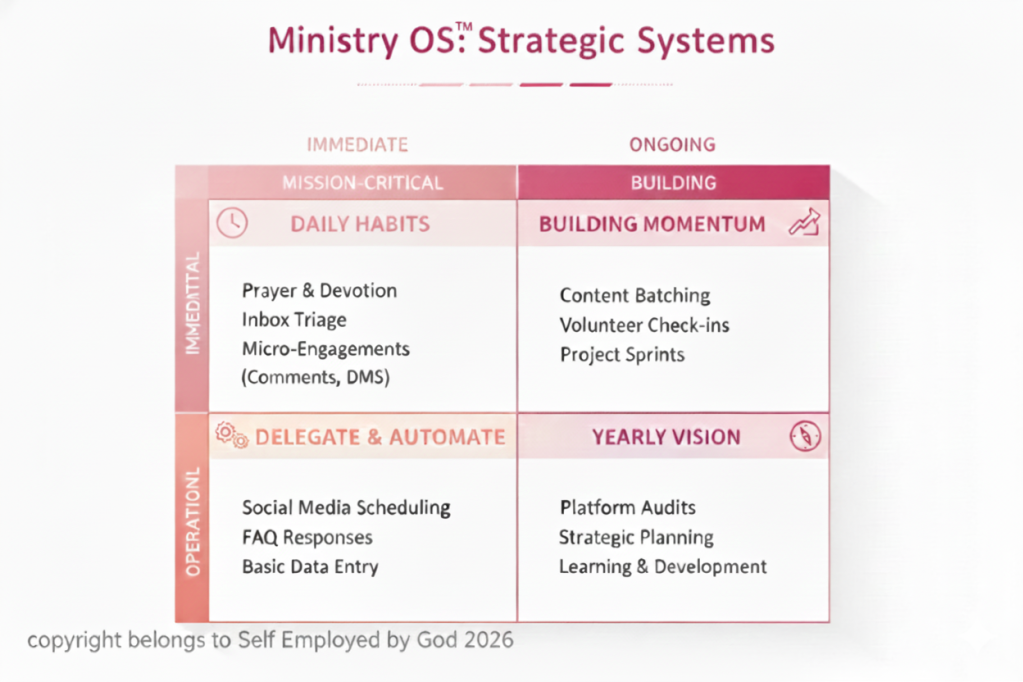
The Patterns of a Healthy OS
To keep your ministry from feeling like a constant emergency, you have to break your tasks into three specific buckets:
1. The Daily Commitments (Maintenance & Connection
This is about keeping the "digital desk" clean. If you don't manage the inflow daily, it will eventually swallow your schedule.
- The 15-Minute Sweep: Start your day by clearing the inbox. Not necessarily finishing every task, but categorising them so you know what’s a "fire" and what can wait.
- Micro-Engagement: Ministry is about people. Spend a few minutes responding to comments or direct messages. It’s small, but it’s how you stay "present" in a digital world.
- Priority Alignment: Don't let your inbox dictate your mission. Name the three things that must happen today. This will be your non-negotiables, a list of tasks you need to prioritise and take action on right now, or within the time-block you set yourself to work on your ministry.
2. The Bi-Weekly Routine (Momentum
This is where you stop being reactive and start being proactive.
- Content Batching: Instead of wondering what to post every week, spend 1-3 days every two weeks creating all your graphics, emails, or outlining your ministry content for your website, podcast or YouTube video.
- The Tech Check: Every two weeks, look at your "numbers." Not for the sake of ego, but to see what your people are actually responding to.
3. The Yearly Check-in (Vision
Once a year, you need to step back and look at the "business side of your ministry" itself.
- The Subscription Audit: If you haven't logged into a tool since last year, unsubscribe today. Stewardship isn't just about how you spend money—it’s about how you stop wasting it on tools that don't serve your specific calling. Just because a software worked for someone else doesn't mean it will work for you, too.
Remember, if it doesn’t save you time, it doesn't belong.
For example, a yearly subscription audit is about identifying and eliminating unused tools, reducing costs and improving the quality of your ministry's mission. It ensures that all subscriptions align with the ministry's current needs, preventing financial expenses that don't or no longer work. It also helps streamline operations by decluttering digital tools that don't serve you or your ministry.
- The User Experience: Pretend you’re a stranger visiting your website or social media for the first time. Is the "front door" easy to open, or is it locked behind broken links and old information? If not, think of ways you can automate the flow of your website to help people navigate your content effectively.
Why This Matters for the Long Haul
Building a Ministry OS™ isn't about becoming a machine. It’s actually the opposite. By automating the "data" part of your job, you create more margin for the "soul" part of your ministry. It also allows you to reclaim back your time for actual ministry work.
When you aren't stressed about when the next newsletter or blog post is going out, you have the mental space to actually sit with someone who is hurting or to dream about where the ministry is going next year.
From Productivity Hack to Spiritual Stewardship
Many people in ministry view "structure" as the enemy of the "Spirit," but biblically, it’s often the exact opposite. We see the value of systems in the very first pages of Scripture. In Genesis, God didn't just speak everything into existence at once. He worked with a deliberate strategy—separating the light from the dark, the land from the sea. He created order out of chaos.
When our ministry workdays feel chaotic, we naturally find ourselves restless and reactive. But when we reflect God’s character by bringing order to our schedules, we find the power to act instead of just react. This shift is vital: it moves us from a simple "productivity hack" to true "spiritual stewardship." We aren't just trying to "get more done"; we are managing the time and the mission we’ve been entrusted with. Freedom in ministry doesn’t come from having a blank calendar; it comes from having a plan so solid that you finally have the mental margin to listen to the Holy Spirit’s prompting.
The First Step To Building Your Ministry OS™
You don't have to build the whole system today. My challenge to you is this: Pick one "recurring" thing that keeps frustrating you or draining your energy every single day. Maybe it’s a manual task you’re tired of doing over and over, or a file you can never quite find when you need it.
Build a system for that one thing this week. Create a template, set a recurring timer, or organise that folder. Then, repeat the process next week.
© 2026 SELF EMPLOYED BY GOD | ALL RIGHTS RESERVED.
